The months May through August are when multifamily properties commonly make or lose the year. Demand concentrates, lease expirations pile up, and prospects are actively comparing options. The communities that come out on top aren’t relying on flashy amenities to do the work. Instead, they are running tighter processes across marketing, lead funnel management, and overall on-site operations.
What separates these communities comes down to a few specific but key decisions: how channels and ILS listings are managed, how leads are managed and nurtured, how tours are run, how teams are coached, and whether renewals are treated as the retention play they are.
Key Takeaways
- Peak leasing season runs May through August, when demand, apartment searches, and lease expirations all concentrate.
- Speed wins: lead conversion drops sharply after the first 10–15 minutes, and about 50% of leases close after the fifth touchpoint.
- Only 8.7% of guest-card leads convert on average; top performers reach 16.5% — the gap is execution, not better leads.
- Multiple tour types pay off: properties that offer them see 22% more leads, and prospects who take two or more are 79% more likely to lease.
- Start renewal outreach 120 days out; unit turnover commonly costs $3,000–$5,000.
Where the Market Sits Heading into Summer
Heading into summer, supply pressure from the past two years of deliveries has eased while demand holds steady across most major metros, handing operators real pricing leverage. The prospect profile has shifted too: renters now expect digital touchpoints (virtual tours, online payments, text) as standard, and teams that treat them as optional already have a conversion gap.
Marketing Channels: Where to Focus Your Spend
ILS Listings Earn or Waste Budget Based on Quality
Without a doubt, Internet Listing Services (ILS) generate significant traffic. However, the gap between quality listings and neglected ones is noticeable. Properties with professional photos, accurate pricing, and complete unit descriptions land considerably more qualified, serious inquiries than those without (Multifamily NEXT, 2026).
The Suggestion? Run an audit of every active ILS listing this week:
- Photos should be current within 6 months.
- Pricing synced to actual availability.
- Amenities described with specifics: ‘rooftop terrace with city views’ does more weight-bearing work than ‘outdoor space’.
- Track cost-per-lease by platform alongside lead volume. This conversion data tells you where the budget really should go.
Paid Search Rewards Specificity
Broad keywords are expensive during peak season; long-tail terms (neighborhood, commute, pet policy) bring higher-intent traffic at lower cost. Apartment-related mobile searches peak in June and July, Zillow reports (2025), so landing pages need to load fast, work on mobile, and schedule a tour in two taps or fewer. A purpose-built platform like ResMan Websites delivers exactly that: fast mobile pages, ILS syndication, and built-in scheduling.
Social Content: Better Now than Never
Short-form video on Instagram and TikTok is now a real discovery channel for Millennial and Gen Z renters, who are 57% of today’s apartment hunters (Apartments.com, 2026). Lifestyle content (real-time units, community moments, amenity use) outperforms most promotional posts. Starting in May or June still pays off: it seeds retargeting audiences and compounds through July and August.
CRM Discipline: Where Leases Are Lost
Response Time Is the Biggest Variable You Control
When a prospect inquires during peak season, they’ve likely pinged two or three other properties too. Conversion probability drops sharply after the first 10–15 minutes (Conversion Realtor, 2026), so the first response needs to be fast, specific to the unit they asked about, and include a tour-scheduling link. An AI leasing assistant fires that off within seconds, any hour, with a handoff to a human when it matters.
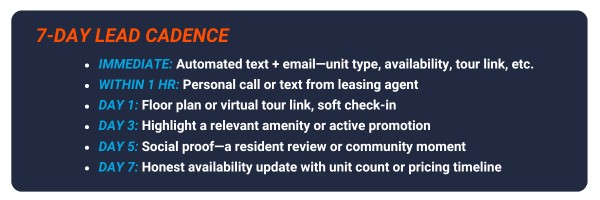
Build a Follow-Up Cadence that Runs Itself
Most leasing teams follow up once or twice and let leads go cold, but most lease decisions take several touchpoints. An automated cadence removes the dependency on agent memory during your busiest weeks. ResMan’s CRM runs the full multi-touch sequence to completion, and properties on it see a 30% lift in lead-to-lease conversion and 52% more scheduled tours.
Segment Leads by Timeline and Intent
A prospect with a 30-day move-in window and a specific unit type in mind needs different follow-up than someone doing early research for September. CRM tagging by move-in timeline, unit size, and lead source lets you match messaging to where each prospect truly is in their decision, which meaningfully improves tour-to-application conversion.
Leasing Velocity: From Tour to Signed
The Tour Is a Conversion Tool
How well an agent connects the property to a prospect’s real needs matters more than the property’s own features.
Data from ResMan’s leasing-funnel analysis of 1.5 million leads across 4,300 properties shows only 8.7% of guest-card leads convert to a lease on average, while top-performing properties reach 16.5% (nearly double) through stronger follow-through during and after the tour. Prospects who complete a tour are 63% more likely to sign, because the tour is where interest becomes intent.
Reciting an amenity list loses to asking two good questions and actually listening. A half-day discovery-led tour training, even done this week, will show up in conversion rates by the end of the month.
Self-guided and virtual tours extend your availability beyond business hours and serve early-stage researchers who aren’t ready for a staffed showing. The goal is running both in parallel: staffed tours for closing, self-guided for top-of-funnel reach. ResMan’s leasing tools support agent-guided, self-guided, video, and virtual tours, with agent-level conversion reporting that shows exactly where each prospect drops off.
And as applications come in, ResMan Screening with Digital Income Verification confirms income and identity in real time, while Fraud Detection flags fake or manipulated documents with 99.8% accuracy and ID Validation confirms the applicant is who they say they are. Together they screen out fraudulent applicants before they reach your team. Nearly 1 in 10 application financial documents is now fraudulent.
Urgency That’s Real, Not Manufactured
Honest urgency works. Transparent unit scarcity, a genuine move-in promotion ending Friday, a real waitlist — each of these accelerates decisions without pseudo-scarcity. Vague or invented urgency gets seen through by renters who have already done their research, and it erodes the trust you need to close. During peak season, real market conditions provide plenty of legitimate urgency if your team knows how to surface it.
Staff Readiness: Train Before the Rush, Not During It
Leasing teams that are current on objection-handling, pricing fluency, and CRM workflow convert at higher rates through the season’s peak weeks. Targeted, recent training is one of the clearest separators between teams that start the season strong and teams that sustain performance through it.
Track individual agent conversion rates alongside team totals. Agents who struggle at a specific stage need targeted coaching, and team averages tend to obscure exactly where those gaps are.
By week six, burnout is real: stretched agents give worse tours and make fewer follow-up calls. ResMan’s AI Leasing Assistant and Contact Center absorb the front-line volume (inquiry routing, FAQs, after-hours calls), so your team’s energy goes to the interactions that close. On the average property, more than 70% of leasing calls go unanswered, and 57% of those callers hoped to tour within 24 hours.
Renewals: The ROI Already in Your Portfolio
Turning over a unit during peak season carries real costs: vacancy loss, make-ready, and leasing fees commonly total $3,000–$5,000 per move-out.
A renewal at a modest concession almost always wins on net. Start outreach 120 days before expiration, before residents compare alternatives, and personalize by tenure and unit type; recognized residents renew at higher rates than those who get a standard notice. ResMan’s CRM can automate that outreach on a set timeline and flag at-risk residents from engagement signals before they give notice.
The retention gesture doesn’t need to be expensive: a waived fee, upgraded parking, or a small gift card at renewal signing costs far less than a vacant unit in July.
Frequently Asked Questions
When is peak leasing season for apartments?
For most U.S. multifamily markets, peak leasing season runs from May through August, when rental demand, apartment searches, and lease expirations concentrate. Apartment-related searches typically peak in June and July.
How fast should you respond to a rental lead?
As fast as possible, ideally within a few minutes. Lead conversion probability drops sharply after the first 10–15 minutes, per Conversion Realtor, so an automated or AI-assisted first response is the highest-leverage speed advantage in peak season.
How many follow-ups does it take to lease an apartment?
On average it takes four to six outbound touches per inquiry, and about 50% of leases close after the fifth touchpoint, per LeaseHawk. Yet most agents stop after one or two. An automated CRM cadence keeps every lead active.
What is a good lead-to-lease conversion rate in multifamily?
Across ResMan’s analysis of 1.5 million-plus leads, the average property converts about 8.7% of guest cards to signed leases, while top performers reach 16.5%. The difference comes from execution at each funnel stage, not better leads.
How early should you start renewal outreach?
Start about 120 days before lease expiration, before a resident begins comparing alternatives. With industry estimates putting turnover at $3,000–$5,000 per unit, a modest renewal concession almost always wins on net.
Is Your Team Ready for Peak Season?
Use the Peak Season Readiness Scorecard below to benchmark where your property stands across marketing, CRM, and leasing execution. Answer a few quick questions, add your name and email, and you’ll get your readiness score with a section-by-section breakdown and specific guidance on where to focus before peak season.