Budget season has a way of making every number feel final. Revenue gets forecast, expenses get assigned, capital plans take shape, and everyone leaves the budgeting process with a clearer picture of what the year ahead should look like.
But a budget is only a plan.
Once the year begins, NOI is shaped by hundreds of operational decisions made across a property portfolio: whether a resident renews, how quickly a delinquent balance is addressed, how long a unit sits vacant between residents, whether a maintenance issue becomes a larger repair, how vendors are managed and whether leadership can see a problem early enough to do something about it.
That matters in the current multifamily environment. CBRE’s 2026 U.S. Real Estate Market Outlook Midyear Review maintains a forecast of 1.4% average annual rent growth and a 4.9% vacancy rate for 2026, while noting that operators are prioritizing occupancy over rent growth and benefiting from historically strong renewal activity.
In other words, there may be less room to rely on top-line rent growth to make up for operational inefficiencies.
So, as you build next year’s budget, it is worth asking a different question: Where could day-to-day decisions cause the budget to leak?
What actually protects NOI after the budget is set?
Net operating income is ultimately a simple equation: revenue minus operating expenses. The difficult part is that the factors affecting both sides of that equation are constantly moving.
A renewal decision can determine whether a unit produces uninterrupted rental income or creates turnover costs and vacancy loss. A delayed work order can become a larger expense. A vendor invoice can reveal a recurring maintenance issue—or a lack of cost control. A delinquent balance can sit on a report long enough to make it much harder to recover.
Those decisions rarely appear as one dramatic line item. Instead, their impact accumulates across the portfolio.
That is why budget season is a useful time to look beyond the spreadsheet and examine the operational processes supporting the numbers.
1. Protect the revenue already inside your properties.
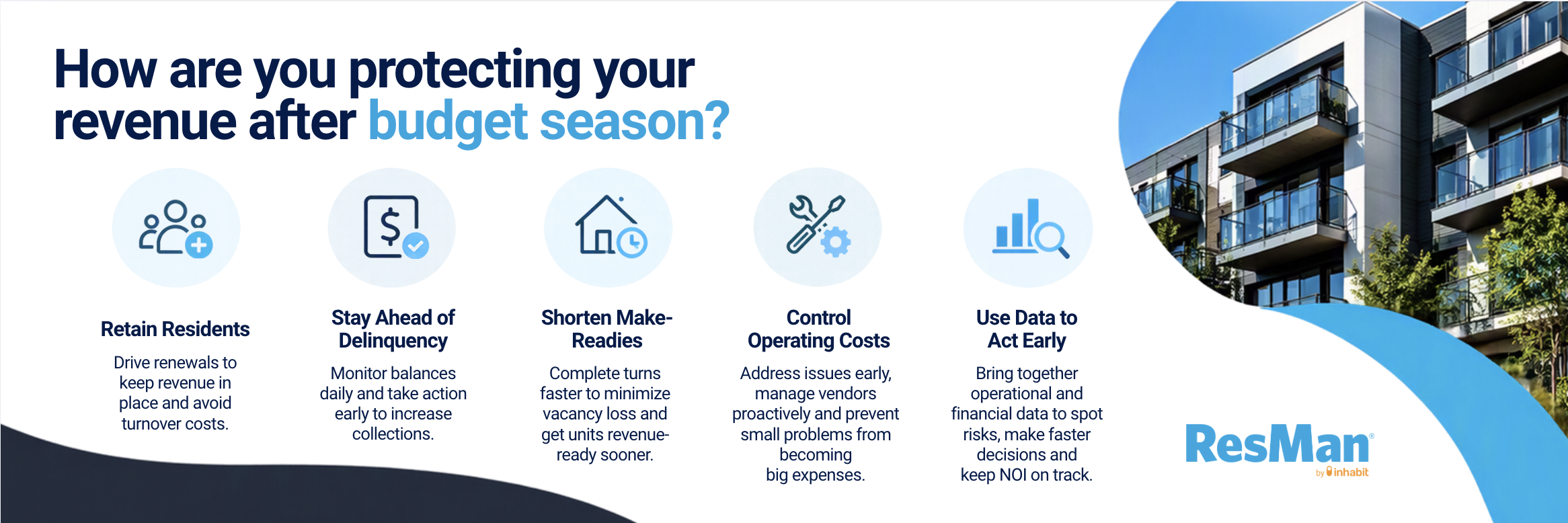
New leases often get the attention during leasing discussions, but renewals can have an equally important effect on NOI because retaining a resident can avoid the costs and revenue disruption associated with turnover.
CBRE’s 2026 Multifamily Outlook reports that renewals represented 57% of all leasing activity, up from 51% in 2015 and 48% in 2005. CBRE also notes that renewals reduce turnover costs and the risk of vacancy, and dramatically outpace new leases for rent growth.
That makes renewal management an operational decision with budget implications.
The question for property teams is not simply, What renewal rate are we budgeting for? It is also, How early can we identify residents who are likely to renew, at risk of leaving or likely to require additional engagement?
When leasing teams can see upcoming expirations, resident history, offer activity and occupancy information together, they have more context for acting before a notice becomes a vacant unit. That creates an opportunity to manage the revenue side of the budget continuously rather than waiting for a variance report to show that occupancy has already slipped.
Budget-season question: What renewal assumptions are built into the budget, and what operational process will support them throughout the year?
2. Treat delinquency as a daily revenue decision.
Revenue on a budget does not automatically become collected revenue.
Delinquency can create a gap between what a property expects to earn and what actually reaches the books. That makes collections another area where consistency matters just as much as the annual assumption.
Recent data from Chandan Economics illustrates why timing matters. Its August 2026 Rental Performance Report, which tracks independent landlords, found that the multifamily on-time payment rate increased to 82.5%, while the forecast full-payment rate across independently operated rentals reached 95.7%. The report also found that late-payment rates remained at 12.1% in June after improving from early-2026 highs.
The broader takeaway is not that every portfolio should expect those exact rates. It is that payment behavior changes over time, making visibility into collections an ongoing operational need.
Teams need to know where balances are accumulating, which accounts require attention and whether collection activity is moving those balances in the right direction. Waiting until month-end to understand a growing delinquency problem can leave fewer options for correcting the variance.
That is where connected financial and operational data becomes valuable. When occupancy, leasing and delinquency information can be reviewed alongside financial performance, teams can identify where revenue is beginning to deviate from the budget and investigate the operational reason behind it.
Budget-season question: If collections begin trending below the assumption in your budget, how quickly can your team identify the cause and respond?
3. Shorten make-readies to reduce vacancy loss.
Vacancy is one of the clearest examples of how an operational process can affect revenue.
A unit cannot generate rental income while it is vacant, and the clock does not stop while teams coordinate inspections, repairs, cleaning, vendors and final readiness. The longer those activities take, the longer the property goes without that unit producing revenue.
Demand in 2026 makes those days harder to justify. CBRE reported a 4.3% national multifamily vacancy rate in Q2 2026, with 167,000 units absorbed during the quarter.
For operators, the implication is straightforward: every vacant unit represents an opportunity to examine what is driving the time between move-out and move-in.
That starts with visibility. If a property manager can see which units are waiting on an inspection, which work orders remain open, which vendor tasks are incomplete and which turns are approaching their target dates, the team has a better opportunity to intervene before another vacant day is added.
This is where maintenance operations and financial performance intersect. A make-ready board is not simply a maintenance tool; it can help teams understand where vacancy-related revenue is being delayed and where process improvements could protect it.
ResMan Maintenance brings work order management, make-ready boards, inventory tracking and project management into the same maintenance environment, while InCheck adds inspections and preventive maintenance capabilities.
Budget-season question: What assumptions about vacancy and turn time are in your budget, and can your teams see when day-to-day execution starts moving those assumptions in the wrong direction?
4. Control maintenance and vendor costs before they become budget variances.
Some operating expenses are difficult to predict perfectly as maintenance volume changes, parts prices move, vendor availability fluctuates, and unexpected repairs occur.
That does not mean those costs have to be invisible.
The National Apartment Association’s Q2 2026 Apartment Labor Market Dynamics Report found that unique apartment-industry job postings increased 13.7% year over year, with maintenance technician postings up 8.9%. Median advertised salaries for maintenance technicians also increased 3.8% year over year.
For operators, labor availability and cost can influence how maintenance work gets assigned and how heavily properties rely on outside vendors. That makes vendor oversight an important part of protecting the expense side of NOI.
The goal is not simply to find the lowest-cost vendor. It is to understand the full operational picture: who is completing the work, how long it takes, whether the issue is resolved the first time, what materials are being used and how those costs compare across properties.
A recurring maintenance issue that is difficult to see at the individual work-order level can look very different when viewed across months or multiple properties.
Connected maintenance data can help teams move from What did we spend? to Why are we spending it?
ResMan allows teams to track inventory items, purchase orders and charges associated with work orders by unit, building and common area, while its maintenance workflows provide visibility into work orders and make-ready activity.
Budget-season question: Which maintenance and vendor expenses are consistently difficult to forecast, and do you have enough operational detail to understand what is driving them?
5. Catch variances while you can still act.
A budget variance tells you something moved. A preventable one tells you it could have been caught sooner.
By the time a monthly report shows that maintenance spending is significantly above plan, occupancy has fallen below expectations or delinquency has accumulated, the opportunity to prevent the problem has already passed.
This is why reporting should be viewed as part of the operational process rather than the final step after the work is done.
The 2026 NAREIM Technology, Data & AI Survey found that firms rated their data quality at 6.2 out of 10, while 58% reported that they still do not have a formal technology budget model. The research involved 72 professionals across 38 real estate investment management firms and points to a broader challenge: organizations can have plenty of technology while still struggling to create the data foundation needed to use it effectively.
For property operators, the practical question is whether the people responsible for daily decisions can access the information they need without manually piecing it together.
When leasing, maintenance, accounting and operational information live in disconnected places, it becomes harder to connect a change in performance to the activity causing it. When those data points are easier to access together, teams can spend less time assembling the story and more time acting on it.
ResMan’s reporting capabilities include hundreds of pre-configured reports with drill-down and export capabilities, along with an optional AI-enabled reporting solution designed to provide real-time insights and reduce manual reporting work.
That visibility can make the difference between reviewing what happened and identifying what needs attention next.
Budget-season question: When a number starts moving away from budget, can your team quickly trace it back to the operational activity behind the variance?
The budget works better when operations can support it.
Budget season should give your team more than a set of financial targets. It should give you a framework for identifying the operational behaviors that need to support those targets.
If the budget assumes strong occupancy, renewal processes need to support resident retention. If it assumes controlled maintenance spending, teams need visibility into work orders, recurring issues and vendor costs. If it assumes predictable vacancy, make-ready processes need clear ownership and timelines. If it assumes revenue will be collected on schedule, delinquency needs consistent attention.
And if leadership is expected to manage all of those variables, the information needed to make those decisions cannot stay buried across spreadsheets, disconnected reports and separate workflows.
That is where ResMan can become part of the budget-season conversation.
BudgetsPro allows teams to create, review, revise, approve, publish and reforecast budgets within the ResMan platform, with data flowing directly from the accounting system into the budget. Teams can also use workflows, templates, global budgeting and bulk calculations across properties.
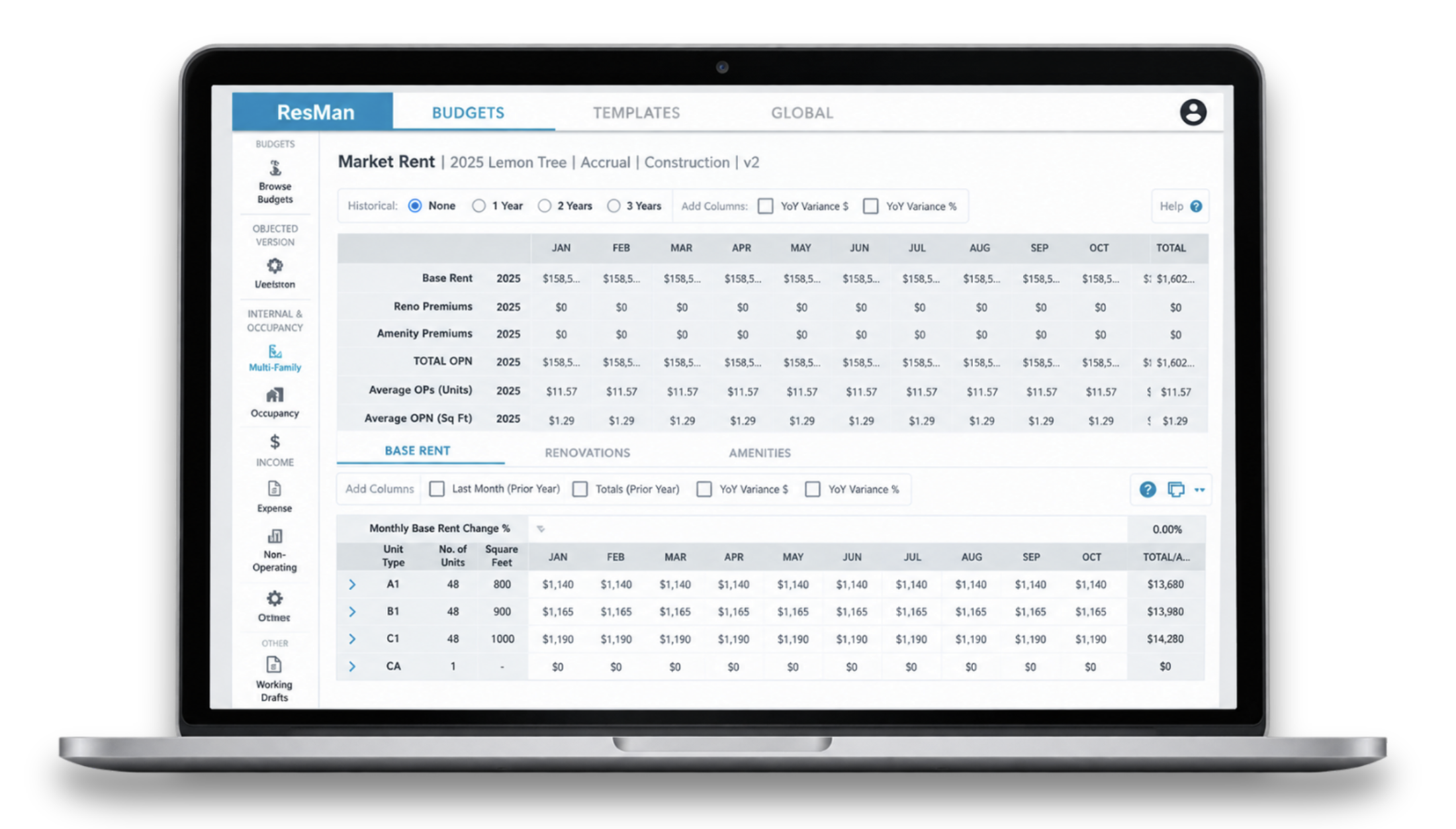
But the value of a connected platform extends beyond building the budget itself. ResMan connects budgeting with the operational systems teams use throughout the year, including leasing, payments, maintenance, reporting and more.
That creates a more useful budget-season mindset: Build the budget. Connect it to operations. Monitor the decisions that move it. Reforecast when reality changes.
Protecting NOI is rarely about one major decision. It’s about whether the hundreds of smaller decisions across the portfolio are moving in the same direction.
Are you seeing NOI leakage before it becomes a budget problem?
If you know your NOI target but are less certain about where operational leakage may be occurring, start with the areas that have the greatest potential to affect revenue and expenses: vacancy, maintenance, delinquency and reporting visibility.
When you’re ready to connect your budget to the day-to-day operations behind it, see how ResMan can help your teams build, manage and reforecast with greater visibility.
Frequently Asked Questions
What is NOI in multifamily property management?
Net operating income (NOI) is a property’s total revenue minus its operating expenses, before debt service and capital expenditures. For multifamily operators, it moves with rent collected, vacancy loss and day-to-day costs like maintenance, turnover and vendor spend, which is why operational decisions shape it long after the budget is set.
How do renewals affect NOI?
Renewals protect NOI by avoiding the turnover costs and vacancy loss that come with a move-out. CBRE reports renewals made up 57% of all leasing activity in its 2026 multifamily outlook, up from 51% in 2015, which makes early visibility into upcoming expirations and at-risk residents a revenue decision, not only a leasing one.
What is vacancy loss and how can operators reduce it?
Vacancy loss is the rental income a property gives up while a unit sits empty. Operators reduce it by shortening the time between move-out and move-in. Tracking make-ready status, open work orders and vendor tasks in one place helps the team spot a stalled turn before it adds more vacant days.
How can property managers catch budget variances earlier?
Review operational data alongside financial performance throughout the month, not only at month-end. When occupancy, delinquency, work orders and vendor costs are visible together, teams can trace a number moving off budget back to the activity causing it and correct course while there is still time to change the result.