Growth shapes a multifamily business, but that’s a given, right? At a smaller scale, a few spreadsheets, disconnected applications, and manual workarounds may be manageable. A property manager knows where to find the information they need, an accountant can track down a missing number, and a regional manager can make a few calls to get everyone on the same page.
Then the portfolio multiplies.
More properties mean more residents, more transactions, more employees, more reporting requirements, and more moving pieces. The systems that once helped the business operate are now creating extra work. A process that used to take five minutes at 500 units can become a recurring drain on time at 5,000.
This is the technology challenge facing many mid-market multifamily operators today. The question isn’t simply whether your technology can handle more units, but whether it can handle more complexity without creating more friction.
For operators moving beyond the small-business stage, that distinction especially matters. You may not need the infrastructure or organizational complexity associated with a massive enterprise, but you may have already outgrown the technology strategy that got you to today.
Your business has changed. Has your technology strategy changed with it?
What Is the Mid-Market Technology Gap?
Mid-market multifamily sits in a unique position. Smaller operators often prioritize simplicity, while enterprise organizations can dedicate substantial resources to specialized technology teams, complex integrations, and extensive technology ecosystems. Mid-market operators need something in between: enough operational depth to support a growing portfolio without creating a technology environment that requires an entire department to manage.
Recent research suggests technology adoption is already changing as multifamily organizations grow. Multifamily Insiders’ 2026 Technology Adoption Report surveyed 118 companies, from portfolios as small as 20 units to more than 200,000units, and found meaningful differences in technology adoption by portfolio size. Among operators with more than 25,000 units, adoption reached 100% for online payments, resident portals, online service requests, and financial and business intelligence tools. Smaller operators trailed their larger peers across most front-office and communication categories, with gaps approaching 50 percentage points in some areas.
The takeaway: technology needs to scale with the business.
That makes this a useful point to evaluate your own operation. Is your business too big for your software?
The warning signs: adding a property requires extensive manual setup, accounting and operations are working from different versions of the data, regional managers rely on spreadsheets to compare communities, or employees spend more time moving information between systems than acting on it.
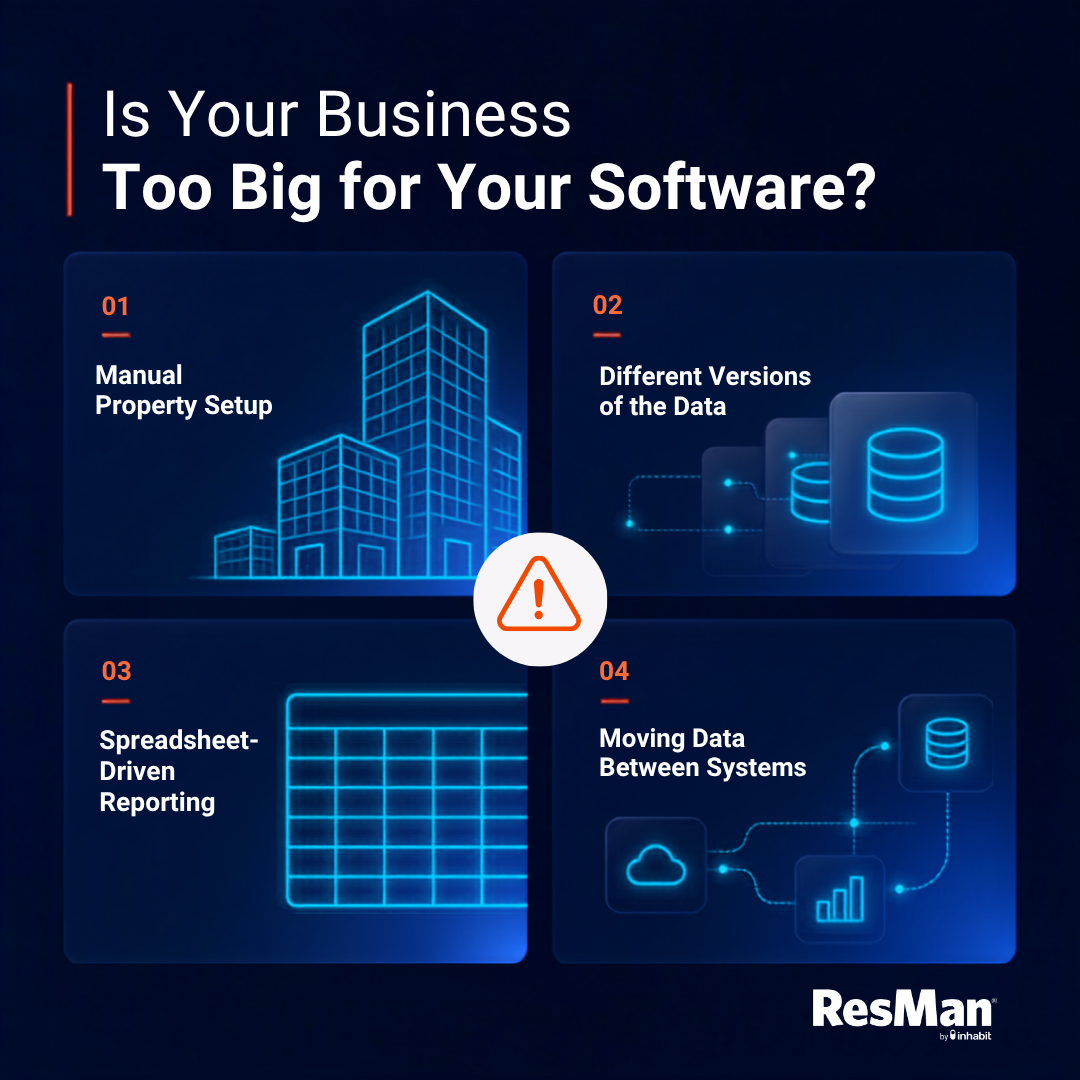
These issues rarely appear all at once. They accumulate as an organization grows, until technology that technically works begins requiring too much human effort to keep working.
That’s where technology strategy becomes an operational strategy.
Growth Exposes the Cracks in Your Technology Stack
Consider the experience of a prospective resident. Marketing generates the lead, leasing follows up, screening verifies the applicant, the lease is executed, payments begin, accounting records the transaction, maintenance handles work orders, and management monitors performance. To the resident, that should feel like one connected experience.
Behind the scenes, however, it can involve multiple systems, teams, logins, exports, spreadsheets, and manual processes. As the portfolio grows, those connections become just as important as the individual functions themselves.
That’s particularly relevant in today’s leasing environment. NAA’s 2026 Spring Leasing Preview notes renters expect “speed, clarity and convenience,” while operators continue navigating elevated operating costs and a sharper focus on technology-supported workflows. At the same time, NAA’s Q2 2026 Apartment Market Pulse reported 340,245 annual apartment completions compared with 271,277 units of annual absorption, meaning new supply continued to outpace demand.
For operators competing in that environment, operational friction becomes harder to absorb. A slow response to a prospect, outdated availability information, or a disconnected payment or leasing workflow can affect the resident experience and ultimately the performance of the property.
The hidden cost of disconnected technology often isn’t found on a software invoice. It shows up in the work employees do around the software: exporting reports because two systems don’t share information, updating spreadsheets because a dashboard doesn’t provide the right view, manually entering information into another application, or emailing another department to confirm which number is accurate.
One workaround may take five minutes. Multiply that across employees, properties, and thousands of transactions, and the operational cost becomes much harder to ignore.
That’s why growing operators should evaluate technology based on more than the features inside each application. The more important question is whether the technology reduces the amount of work required to run the business.
Your Technology Should Connect the Business
A growing technology stack shouldn’t just give every department its own tools. It should help those tools work together.
Marketing needs visibility into leads, prospects, and leasing activity. Leasing needs accurate availability, applicant information, screening results, and resident data. Payments need to flow cleanly into resident accounts and accounting processes. Accounting needs reliable operational data for financial reporting, while leadership needs a clear view of performance across properties and portfolios.
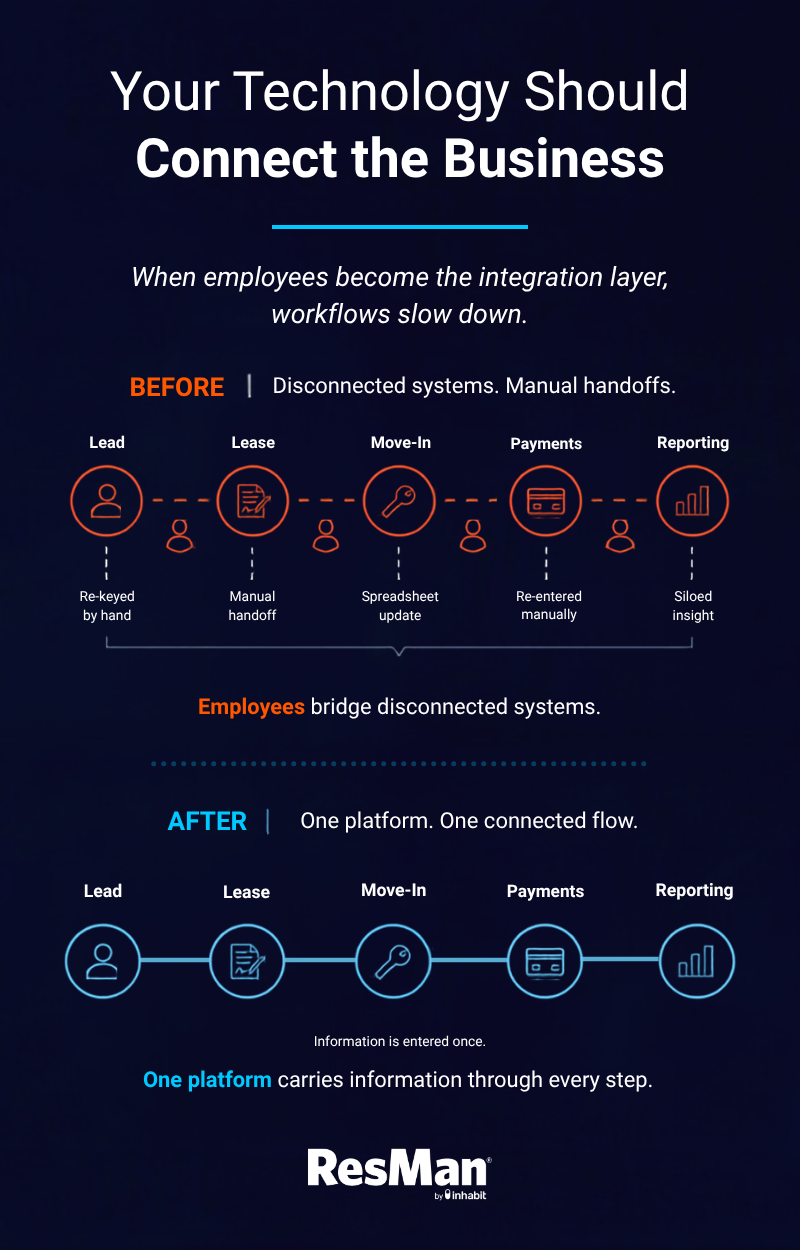
When those functions operate in separate systems with limited connectivity, employees become the integration layer. They download reports, update spreadsheets, copy information between applications, and reconcile numbers.
That might be manageable at a smaller scale. As the portfolio grows, it becomes an increasingly expensive way to operate.
The industry is increasingly focused on what happens to all the data generated by these systems. Zillow’s 2026 coverage of RETCON highlighted multifamily leaders’ growing focus on turning the industry’s expanding volume of data into decisions across leasing, marketing, and asset strategy.
The challenge is making that data usable.
This is where a connected platform becomes valuable. ResMan brings core multifamily functions together across accounting, marketing, payments, leasing, reporting, and other operational workflows, giving teams a common technology environment rather than requiring employees to manually bridge every system gap.
For a mid-market operator, that can mean less time spent moving information between systems and more time using it to make decisions. Marketing can connect to the leasing process. Payment activity can connect to resident and back-office workflows. Accounting can maintain visibility into financial activity. Leadership can move from individual property information to portfolio-level performance.
As the business becomes more complex, the technology should help keep it connected.
Growth Changes What You Need From Implementation and Support
There is another question growing operators should ask when evaluating technology: How well will this platform support our growth?
Imagine winning a new management contract. The portfolio fits your strategy and the team is ready to get started. Then implementation begins. How long does it take to configure the property, move and validate data, train employees, establish reporting, and connect the necessary systems?
A complicated implementation can consume internal resources and delay operational readiness, particularly for mid-market organizations where existing teams are already balancing multiple responsibilities. For an operator pursuing growth, every new property shouldn’t feel like a one-off technology project. The process should become repeatable.
ResMan’s implementation process includes a dedicated project manager, milestone planning, weekly status calls, data migration support, and training. Certified implementation partners can also provide additional support when needed.
Support matters after implementation, too. As an organization grows, new employees join, processes evolve, properties come online, and technology needs change. ResMan’s Customer Advocacy Partners work with customers to help maximize operational efficiency, revenue, and NOI, supported by implementation, training, and ongoing customer resources.
For mid-market operators, that support can be just as important as the software itself. Your team shouldn’t have to become a technology department simply because the business is growing.
Why Does Visibility Get Harder as You Grow?
Scale also changes the amount of information leadership needs to manage. A property manager needs to know what’s happening at one community. A regional manager needs to compare several. An executive needs to understand portfolio-level performance.
The information exists at each level. The challenge is getting the right information to the right person without creating another reporting project.
That becomes especially important when market conditions vary from one location to another. NAA’s Q2 2026 Apartment Market Pulse shows meaningful differences in apartment market performance across metros, reinforcing the need for operators to understand what is happening within their own portfolios rather than relying on broad market assumptions.
A growing operator should be able to move from “What happened?” to “Why did it happen?” to “Where should we focus next?” That requires timely, connected data.
ResMan Reporting provides hundreds of financial, operational, accounting, and leasing reports using live data, with the ability to view information at the property, group, or portfolio level and drill into underlying details. BoardRoom adds customizable KPI visibility so teams can monitor the metrics that matter most to their business.
The result is a path from property-level information to portfolio-level insight without building an unofficial reporting system out of spreadsheets.
As your portfolio grows, you shouldn’t need to work harder to understand it.
Enterprise Capability Without Enterprise Complexity
This is ultimately the technology gap mid-market operators are trying to solve. You’ve outgrown basic software. But that doesn’t mean you need technology designed around the complexity of a massive enterprise organization.
Enterprise organizations may have dedicated IT resources, specialized technology teams, and complex internal structures designed to manage extensive technology ecosystems. Mid-market operators often don’t have that infrastructure—and don’t necessarily need it. They need technology that can handle sophisticated multifamily operations while remaining practical for the teams using it every day.
ResMan’s conventional solutions include a Scale level specifically designed for SMB+ and mid-sized organizations as they expand operations and scale the business.
That’s an important distinction. Growth isn’t a switch from “small” to “enterprise.” There’s a stage in between where operators need more automation, visibility, connected workflows, financial insight, and scalability while still needing technology that fits the way a mid-market organization actually operates.
That’s where ResMan fits: providing the operational depth to support growth without requiring the organization to build enterprise-level complexity around the software.
Your Technology Should Grow With You
Your technology needs today may look different from your technology needs three years from now. That’s why flexibility matters.
An operator may begin by prioritizing accounting and reporting. As the portfolio expands, marketing automation, resident engagement, payments, screening, maintenance, or other capabilities may become increasingly important. The technology strategy needs to evolve without forcing the organization to start over.
Deloitte’s 2026 Commercial Real Estate Outlook points to the same broader shift. Real estate organizations are exploring AI across areas including tenant relationship management, lease drafting, and portfolio management, but reliable data and application readiness remain important barriers to getting value from those technologies.
The lesson for multifamily operators is straightforward: the technology you choose today needs to give you room to evolve tomorrow.
ResMan’s open platform supports integrations with hundreds of technology and service partners, giving growing organizations room to adapt their technology ecosystem as their needs change.
That means an operator doesn’t have to choose between a connected core platform and the flexibility to add specialized technology. The technology strategy can evolve alongside the business.
Build for the Business You’re Becoming
Mid-market multifamily has changed.
Operators are managing larger portfolios, more complex workflows, higher resident expectations, and increasingly data-driven businesses. At the same time, market conditions are giving operators less room for operational inefficiency.
Technology has a role to play in closing that gap.
The goal isn’t simply to digitize individual tasks. It’s to create an operating environment where information moves, teams stay aligned, growth can be operationalized, and leadership can see what’s happening across the business.
If your organization has grown but your technology strategy hasn’t, the signs may already be there: more spreadsheets, more workarounds, more manual reconciliation, longer implementation cycles, and more time spent figuring out where the information lives.
That’s the point where it may be time to ask a different question: Has your technology strategy kept up with the business you’ve become?
ResMan gives mid-market multifamily operators the operational depth to support growth while keeping the technology practical for the teams behind it.
Enterprise-level capability doesn’t have to mean enterprise-level complexity. Because the goal isn’t to build an enterprise technology stack. It’s to build a better-run multifamily business.
See how ResMan gives mid-market multifamily operators the connected technology, visibility, and support they need to scale. Request a personalized demo.
Frequently Asked Questions
What is considered mid-market in multifamily?
There’s no official cutoff. Mid-market generally means operators who have outgrown small-portfolio tools but don’t have the dedicated IT teams that enterprise platforms assume.
When should an operator replace its property management software?
When the work around the software outgrows the work in it: manual setup for every new property, teams reconciling mismatched data, and spreadsheets standing in for reporting.
What’s the difference between enterprise and mid-market property management software?
Enterprise platforms assume dedicated IT resources. Mid-market operators need the same operational depth, delivered in a platform practical for the teams using it every day.
What does an open API mean for a property management platform?
It lets the platform exchange data with other technology partners, so operators can keep the tools they rely on and consolidate the rest without vendor lock-in.