If someone asked how a property is performing, most operators would probably start with occupancy.
It’s one of the first numbers leadership looks at, one of the first metrics discussed in meetings, and one of the easiest ways to gauge whether a community is moving in the right direction.
But occupancy rarely tells the whole story.
A property can sit at 95% occupied while renewals begin to soften. Leasing teams can generate plenty of traffic while conversion rates slowly decline. Revenue can flatten even though occupancy appears stable.
The signs are usually there long before they show up in a monthly report.
The operators who spot those signals early are often the ones who have visibility into more than just occupancy. They understand how leasing, revenue, maintenance, resident retention, and portfolio performance work together.
That level of visibility is easier to act on when property data is connected in one place. ResMan’s BoardRoom helps operators see portfolio performance, operational priorities, and key KPIs in a centralized view, giving teams a clearer path from insight to action.
That is where KPIs become valuable. They help turn property data into a clearer picture of what’s working, where friction is building, and which opportunities deserve attention.
What Are the Most Important Multifamily KPIs?
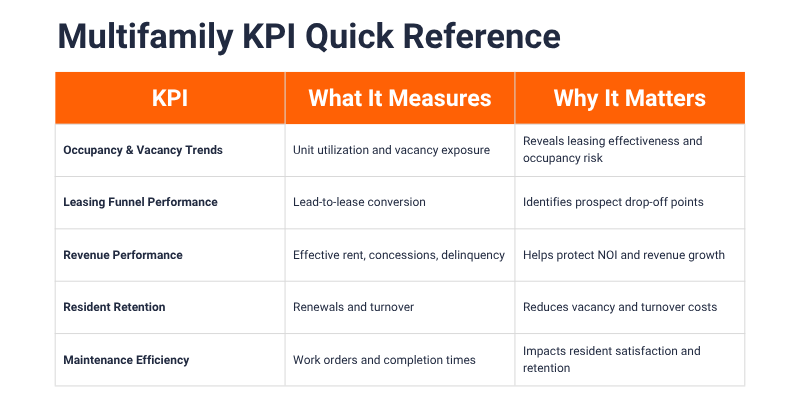
The most important multifamily KPIs for property managers include:
- Occupancy: occupancy percentage, economic vs. physical occupancy, average days vacant.
- Leasing: lead-to-lease conversion, cost per lease, tour-to-app rate.
- Revenue: effective rent, concession value, delinquency percentage, NOI.
- Retention: renewal rate, turnover rate.
- Maintenance: work-order completion time, make-ready time, recurring requests.
Together, these metrics paint the picture of property performance and help operators identify where to focus their efforts and energy.
Why Property Management KPIs Matter
Property management KPIs help multifamily operators evaluate portfolio performance, identify operational inefficiencies, improve resident retention, and make more informed decisions across leasing, maintenance, accounting, and reporting functions.
For growing portfolios, tracking the right multifamily performance metrics creates visibility into what is working, where performance is slipping, and which actions can have the greatest impact.
Occupancy & Vacancy Trends: The Number Everyone Knows & the Story It Hides
Most operators know their occupancy number without opening a report. The more useful question is what is driving it.
Are vacancies taking longer to fill? Are certain floor plans sitting longer than others? Are some communities consistently outperforming the rest of the portfolio?
What matters is the trend, whether that number is climbing, holding, or quietly slipping.
The U.S. apartment vacancy rate sits near 4.4%, still below the 5.2% average from 2010 to 2019, and it is expected to tick up as a record wave of new supply is absorbed (CBRE, 2026).
Together, occupancy and vacancy trends provide greater insight into current performance, emerging risks, and future opportunities.
Leasing Funnel Performance: Where Momentum Builds or Stalls
A busy leasing pipeline can feel encouraging.
Then you discover inquiries are coming in while tours slow down, and applications rise while signed leases remain flat.
Those gaps reveal where momentum is getting lost.
Lead volume only pays off when prospects keep moving through tours, applications, approvals, and signed leases.
Tracking each step in the leasing funnel helps operators find friction points and uncover areas where small improvements can create meaningful gains.
Homeownership remains out of reach for many renters (a 105% premium to buy versus rent and a shortage of about 3.4 million single-family homes), which keeps rental demand steady even as record new supply makes every signed lease more competitive (CBRE, 2026).
As demand shifts across markets, efficient leasing processes help ensure opportunities translate into occupancy.
Revenue Performance: The Small Leaks That Sink NOI
Revenue challenges typically appear in small places first.
A concession that becomes standard practice. A renewal opportunity that slips through the cracks. An increase in delinquency gradually grows month after month.
Individually, those issues may seem manageable.
The truth is that revenue performance is increasingly tied to operational execution. Industry outlooks continue to highlight the importance of occupancy, renewals, and resident retention, making it essential for operators to understand which factors support revenue growth, and which factors create revenue leakage (NMHC, 2026).
Tracking revenue metrics together shows where profit is leaking vs protected.
Resident Retention & Renewal Rates: Today’s Renewals, Tomorrow’s Occupancy
Every renewal affects occupancy, revenue, workload, and resident acquisition costs.
When residents stay, teams spend less time turning units, filling vacancies, and replacing lost revenue. Strong retention also creates more predictable property performance.
Renewals now make up about 57% of all leasing activity, up from 51% in 2015 and 48% in 2005, and renewing residents consistently outpace new leases on rent growth (CBRE, 2026).
For operators, renewal trends are not only a historical metric, they’re also an early look at future occupancy risk and help identify which communities may need additional focus before exposure begins to grow.
Retention remains one of the most effective strategies for protecting revenue, reducing turnover costs, and maintaining occupancy stability.
Maintenance Efficiency: Your Early-Warning System
These KPIs are your early warning systems.
Maintenance metrics provide valuable visibility into both operational efficiency and resident experience. Increasing work orders, slower completion times, recurring service requests, and extended make-ready schedules often signal larger issues that eventually influence resident satisfaction, renewals, and leasing performance.
Properties that consistently monitor maintenance performance are better positioned to identify bottlenecks, distribute resources effectively, and improve the day-to-day experience for residents.
Benchmarking Brings Context to Performance
A KPI becomes more meaningful when it has comparable value.
Without context, even strong performance can be misleading. A community operating at 94% occupancy may appear healthy until another property with a similar unit mix, market, and resident profile consistently performs at 97%.
Similar comparisons can uncover opportunities within leasing, renewals, maintenance, and revenue performance.
The National Multifamily Housing Council’s Market Trends research tracks vacancy rates, rent growth, apartment starts, employment growth, and apartment sales activity, highlighting the value of evaluating performance through multiple benchmarks rather than a single data point.
Benchmarking helps operators identify which communities are excelling, which processes are driving results, and where opportunities for improvement exist.
Better Data is Only Valuable if Action Follows it
Most operators already have access to a tremendous amount of information.
Leasing data lives in one place, but financial and maintenance data live somewhere else.
Multifamily reporting dashboards help operators monitor property management KPIs, benchmark portfolio performance, and identify trends across leasing, operations, accounting, and resident retention. This centralized visibility makes it easier to identify trends, prioritize work, and respond more quickly when issues arise.
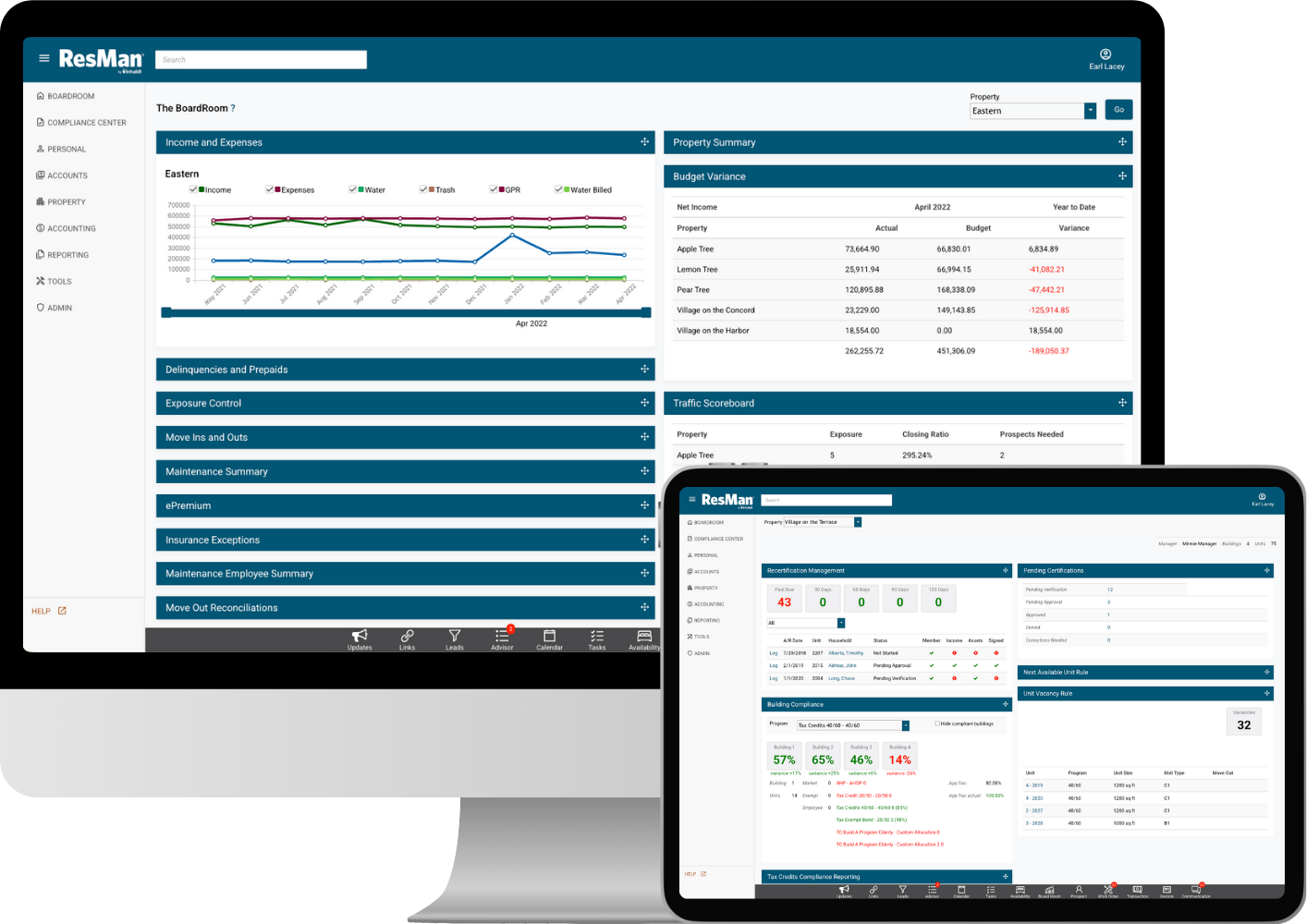
ResMan’s BoardRoom gives teams one transparent view of portfolio performance (occupancy, delinquencies, budget variance, and KPIs), so they can act on issues instead of hunting for them across systems.
When teams spend less time pulling reports together, they gain more time to focus on improving results.
Frequently Asked Questions About Multifamily KPIs
What is the most important KPI in multifamily property management?
Occupancy is one of the most referenced metrics, but the clearest view of property performance comes from reviewing occupancy, leasing performance, revenue trends, resident retention, and maintenance efficiency together.
What KPIs impact NOI the most?
Occupancy, effective rent, concessions, delinquency, leasing conversion rates, renewal rates, and maintenance efficiency can all influence property profitability and NOI.
Why are reporting dashboards important for multifamily operators?
Multifamily reporting dashboards bring critical property data into a centralized view, helping operators identify trends faster, benchmark performance, and make more informed decisions.
How do multifamily operators benchmark performance?
Multifamily operators benchmark performance by comparing property results against portfolio averages, historical trends, business goals, and similar communities in their portfolio.
Better Property Performance Starts With Better Visibility
High-performing multifamily operators rarely rely on a single metric to understand portfolio health.
They look at how occupancy, leasing activity, revenue performance, resident retention, and maintenance trends work together to shape outcomes across their communities.
When those metrics are reviewed consistently, patterns become easier to spot, opportunities become clearer, and decisions become more informed.
With the right reporting strategy and visibility into key performance indicators, operators can identify opportunities sooner, respond more effectively, and make decisions with greater confidence.
Request a demo to see how ResMan BoardRoom turns portfolio data into action.